Voice Memory for Agentic
Speech Recognition
NVIDIA · *Work done at NVIDIA
🎬 The listener–thinker walkthrough
Noisy speech comes in. A frozen decoder emits its 5-best guesses, a frozen corrector reads a
per-domain memory.md, and it makes one decision per utterance: act on the
hypothesis, or abstain and keep the 1-best. Every transcript, hypothesis list, and memory
rule below is real. That was taken verbatim from the HyPoradise test sets and from memories the
optimization loop actually learned.
Step 1: Speech arrives
Step 2: The listener decodes frozen Whisper emits its 5-best hypotheses
Step 3: The corrector reads its memory
Step 4: One decision per utterance
act
abstain
Step 5: Final transcript
What this buys, at benchmark scale
zero weight updates
(CHiME-4)
(over-correction, lower is better)
than the n-best oracle on ATIS
0 parameters added at inference
Method — the listener–thinker architecture
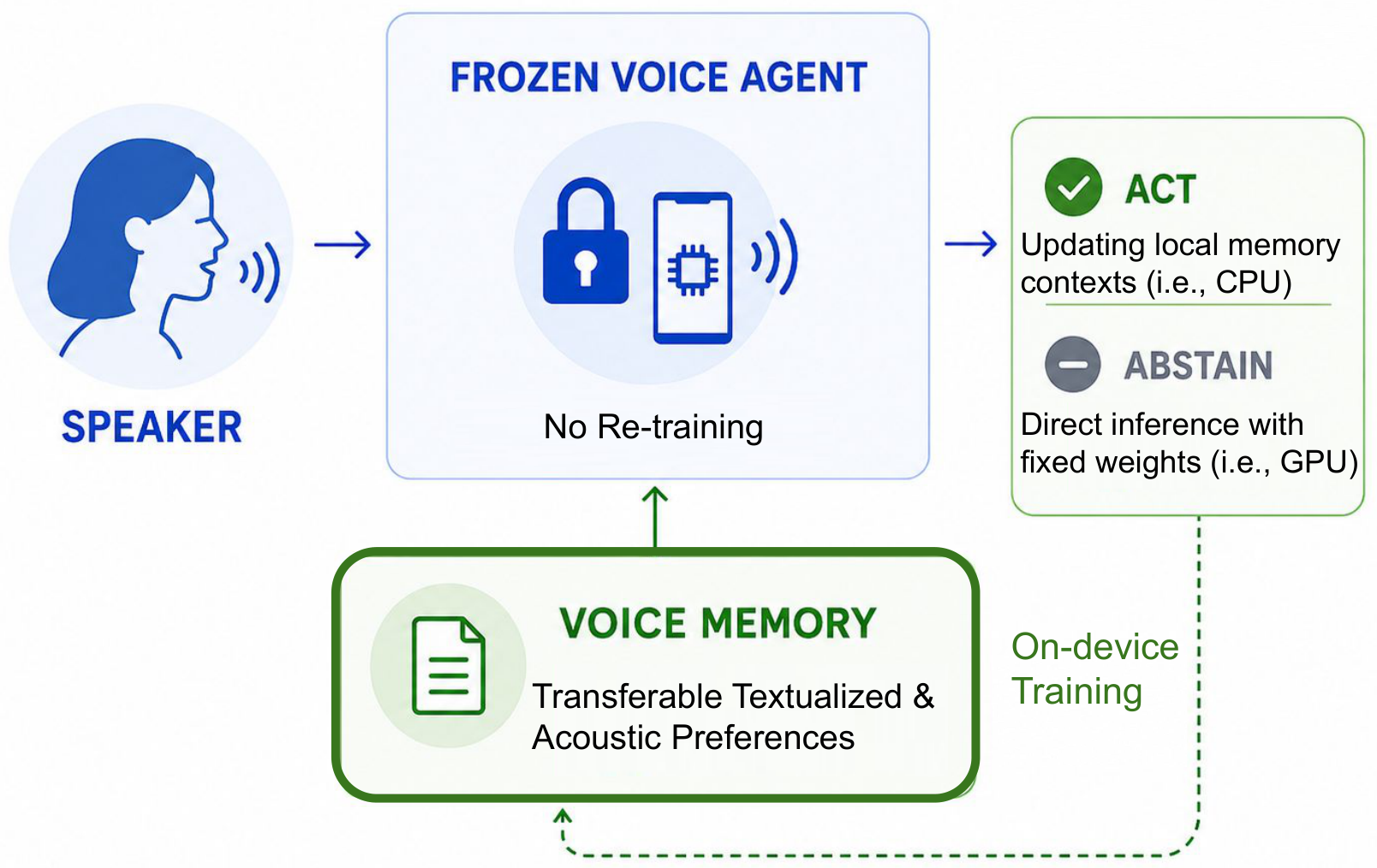
An agentic speech system in the listener–thinker format is a tuple
(Bφ, Mθ, π, s, O). Both models stay frozen; the only thing that
ever changes is the text state s — a per-domain memory.md.
👂 Decode, read, decide
A frozen decoder Bφ maps audio to 5-best evidence H.
A frozen corrector Mθ reads H and the memory
s, then samples one action per utterance.
🧠 Rollout, edit, gate
An optimizer O turns scored rollouts, which failures F and successes
G into bounded edits of the memory. An edit is kept only if it strictly
improves a held-out score v.
The per-utterance decision
act
Edit
Recoverable headroom exists: reconcile the hypotheses, apply the memory's substitutions and formatting rules — sometimes recovering tokens present in no hypothesis (ρ > 1).
abstain
Hold still
The 1-best is already right, or the edit would only trade one surface form for another. Restraint is the skill the loop mostly learns that unconstrained GER breaks correct tokens on up to 64% of its edits.
A learned memory is small and readable
The ATIS memory below was formed by the validation-gated loop with Claude as corrector and optimizer — it reaches ρ = 1.28, above the n-best oracle. Excerpt, verbatim:
# ATIS ASR correction memory (restraint-first)

- RESTRAINT first: keep majority verbatim ASR tokens; edit only a clearly-wrong token.
  Over-correction raises WER.
- Reconcile the 5 hyps by per-position majority vote; the truth is usually the most
  common token.
- Carrier/airport initialisms are spaced letters: "twa" -> "t w a",
  "usair"/"us air" -> "u s air".
- Split run-on tokens: "showflights" -> "show flights", "sevenpm" -> "seven pm".
- Do not invent function words ("in"/"and"/"the"/"a") or place spellings not seen
  in the hyps.
Results
↓ WER — lower is better · ↑ ρ — higher is better (fraction of the 1-best-to-oracle gap recovered)
Breadth — full HyPoradise test, open corrector (Whisper-v2-Large + Qwen3-30B-A3B)
Gains concentrate where recoverable headroom is largest; nothing regresses.
| Dataset | Raw ASR WER ↓ | Voice Memory ↓ | + Few-shot ↓ |
|---|---|---|---|
| ATIS | 8.40 | 3.40 | 3.00 |
| CHiME-4 (noisy) | 12.69 | 10.46 | 10.28 |
| CORAAL | 25.83 | 25.65 | 25.44 |
| CommonVoice | 15.44 | 13.16 | 13.16 |
| LRS2 | 11.85 | 10.69 | 10.78 |
| LS-Clean | 1.79 | 1.63 | 1.64 |
| LS-Other | 3.67 | 3.39 | 3.41 |
| SWBD | 15.86 | 15.47 | 15.33 |
| TED-3 | 4.44 | 4.20 | 4.05 |
| WSJ | 6.03 | 5.38 | 5.36 |
| WEIGHTED | 8.36 | 7.52 | 7.47 |
Noise robustness — Robust HyPoradise (no fine-tuning, no latent noise vector)
Where static GER over-corrects on genuinely degraded speech, the memory recovers up to 47% of the 1-best-to-oracle gap — and correctly abstains where nothing is recoverable.
| Condition | 1-best ↓ | Oracle ↓ | Static GER ↓ | Voice Memory ↓ | ρ (recovered) ↑ |
|---|---|---|---|---|---|
| CHiME-4 · real recorded / simulated far-field noise | |||||
| test-real | 9.8 | 7.8 | 9.9 | 9.5 | 0.17 |
| test-simu | 12.7 | 10.3 | 12.5 | 11.7 | 0.39 |
| dev-real | 7.8 | 6.3 | 8.1 | 7.3 | 0.31 |
| dev-simu | 9.7 | 7.9 | 9.8 | 8.8 | 0.47 |
| NOIZEUS · pooled by SNR | |||||
| 0 dB | 42.9 | 34.9 | 41.5 | 41.4 | 0.19 |
| 5 dB | 14.5 | 9.2 | 14.8 | 12.6 | 0.36 |
| 10 dB | 5.0 | 2.1 | 5.2 | 4.9 | 0.05 |
| 15 dB | 2.7 | 0.9 | 2.7 | 2.8 | −0.06 |
Portability — the memory is the asset, not the model
A second frozen corrector (Claude) reading memories at inference, 100-utterance tests. A MiniMax-written memory transfers; a self-formed one beats the n-best oracle on ATIS.
| Domain | 1-best ↓ | Oracle ↓ | No memory ↓ | + MiniMax memory ↓ | + Self-formed memory ↓ |
|---|---|---|---|---|---|
| ATIS | 8.2 | 4.9 | 6.7 | 6.1 | 3.9 (ρ = 1.28) |
| WSJ | 5.3 | 4.1 | 6.1 | 4.6 | 6.2 |
| LS-Other | 4.8 | 3.3 | 4.3 | 4.5 | 4.8 |
| LS-Clean | 1.9 | 0.7 | 1.7 | 1.8 | 1.8 |
Case gallery
Eight representative cases spanning the taxonomy: Voice Memory fixes genuine errors, suppresses the harmful edits static GER introduces, and in the generative cases recovers a transcript present in no hypothesis. Tokens that disagree with the reference are marked.
BibTeX
@article{yang2026voicememory,
  title   = {Voice Memory for Agentic Speech Recognition},
  author  = {Yang, Chao-Han Huck and Chen, Zih-Ching and {\.Z}elasko, Piotr and
             Chen, Zhehuai and Balam, Jagadeesh and Ginsburg, Boris},
  journal = {arXiv preprint arXiv:2607.26410},
  year    = {2026},
  note    = {Model and learned memories: \url{https://huggingface.co/huckiyang/voice-memory}}
}